NOVEL
A Place for the Dining Table
About 40 min read
Published:
Your reading progress
Progress is saved only in this browser on this device.

Chapter 1: One Rolled-Up Sleeve
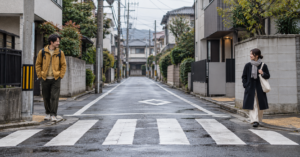
The man I met for the first time at my mother's house had only one sleeve rolled up.
It was the first Sunday in November. As I was about to take off my shoes in the entrance, I met the eyes of a man emerging from beneath the dining table and realized we still had a visitor.
“Careful, by your feet.”
I looked down. A small metal fitting lay just beyond my sock. He picked it up and put it on a folded cloth.
“He's a furniture repairman. He's looking at the chairs,” my mother called from the kitchen.
I hadn't heard anyone was coming. Still clutching my bag, I bowed and said hello.
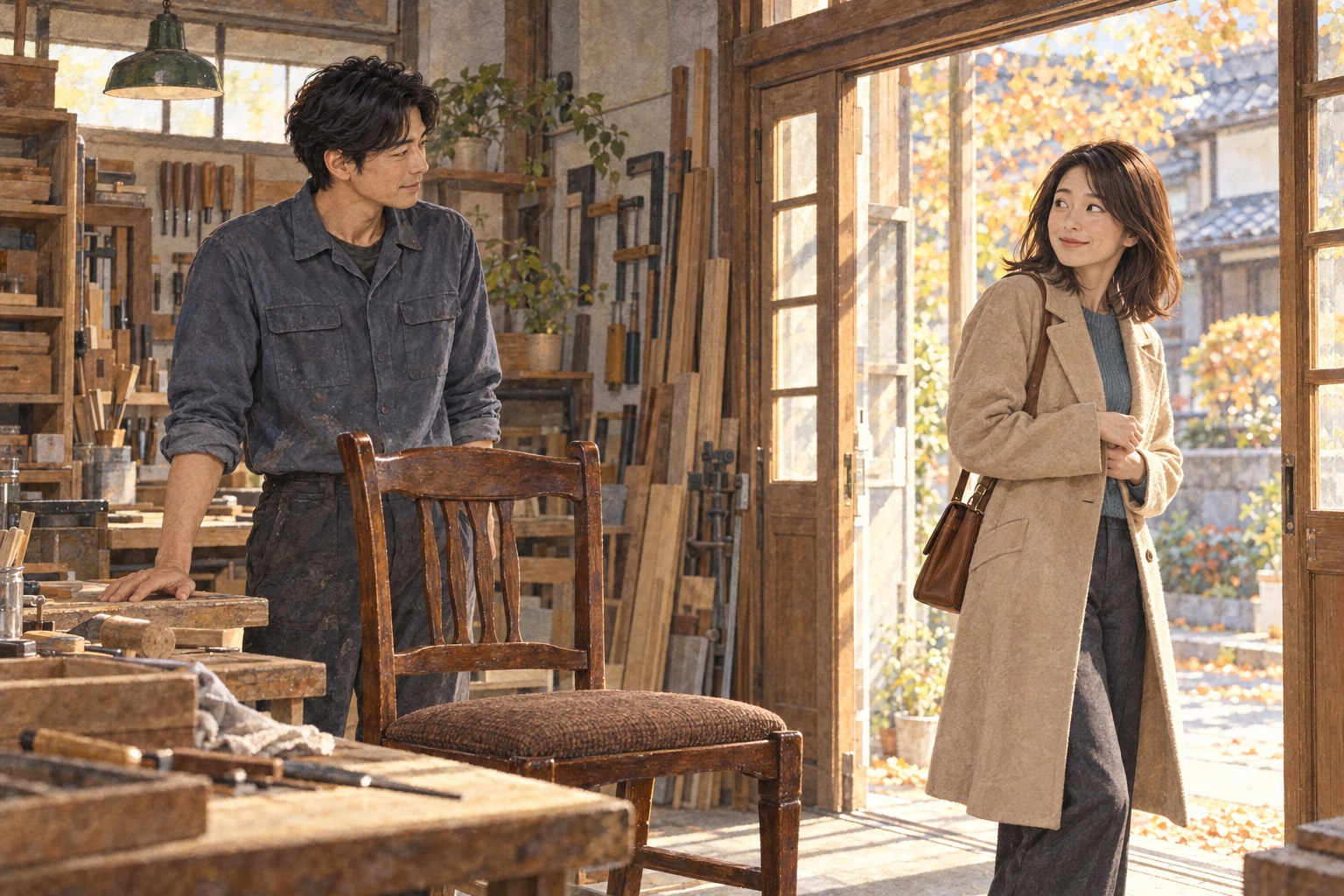
“Mano,” he said. As he went to hand me his card, he seemed finally to notice he'd rolled up only one sleeve. He pushed the other to the same height before holding it out.
Ryo Mano. The card, its corners a little rounded, bore the name of a workshop at the far end of the shopping street.
My mother was sixty-four and leaving the house at the end of the month. It was going to be rebuilt. She couldn't take all the furniture that had been there for nearly thirty years into her new apartment with two rooms and a dining kitchen. I lived about an hour away by train and had agreed to come three times that month to help her sort things.
“You're taking the chairs too?”
“Just two. The other two are for Sudo.”
She named a former colleague from the alterations shop. It was Sudo who had recommended Mano.
Before looking at the chairs, I looked at the table. The red pincushion my mother used for work sat at one end.
“Will this fit in the new place?”
“I measured it,” Mano answered. He didn't sound as if he were defending her; he spoke as though recalling a number he'd been asked for. “She's putting it in the small room with the window.”
I looked at my mother. Without looking back, she set out three teacups. She had said she would keep that room clear for when I stayed over. I had told her she didn't need to, yet hearing it was settled made me a little uncomfortable.
Mano pressed the back of a chair. It made a faint sound.
“I'll redo the glue here. The seat can still be used as it is.”
“Wouldn't it look nicer reupholstered?” I asked.
My mother shook her head. “I like this fabric.”
There was one faintly faded patch on the brown seat. I'd been thinking only of the new room, hardly at all about what my mother would see when she sat down.
Mano pointed to a line on the estimate and explained what he would repair and how long he would need the chairs. My mother put on her glasses, checked the amount and signed her name. Watching how efficiently he worked, I wondered whether he too was someone who wanted to get things over with quickly. But when my mother asked the same question again, phrased a little differently, he answered at the same pace as before.
I held the front door while he carried the chairs out. A potted plant in the garden was in the way, and he stopped.
“I'll tilt it this way a little.”
I stopped reaching for the pot. Holding the chair, he waited for me to move aside. Out on the street, an old blanket lay across the back of his vehicle.
“My mother talks for a long time, doesn't she?”
I didn't know why I'd said it.
“It helped that she already knew where she wanted to use them.”
“I see.”
He draped the edge of the blanket over the back of a chair. I seemed to know nothing about my mother's life, compared with him.
“She said she'd have tea here when her daughter came.”
After he said it, he looked a little troubled. “I'm sorry. I shouldn't have spoken for her.”
“No. There are days I come.”
There was no need to add that it wasn't every week. He nodded and closed the back of the vehicle.
When I went inside, my mother had already opened another drawer.
“He seems nice, doesn't he?”
“He's someone who explains his work properly.”
“Well, he came here for work.”
I went to hang my coat on a chair and realized there were two fewer than before. Standing in the empty space, I saw that the floor beneath the table was brighter than I'd expected.
That afternoon, upstairs, I put notebooks from my student days into boxes. Even at thirty-four, I still had to sort through my old things myself at my mother's house.
As I tucked the card into the bottom of my bag, its corner touched my finger. I might have no reason to see him again. That seemed a small shame. Once I'd thought it, I moved the card beside my wallet.
On the train home, my mother sent me a photograph. Two cardboard boxes stood where the chairs had been.
“It's easier to get through now.”
I started to reply that once the chairs came back, it wouldn't be again, then stopped. In the window's reflection, the hair on one side of my head was sticking out badly. Had it been like that all day? I smoothed it with my hand. Halfway through, I knew who I was worried might have seen it.
Chapter 2: After the Errand
I went to the workshop the following Saturday. I had an envelope of spare screws my mother had asked me to bring. She'd found them in a drawer of the cupboard and thought they might be useful for the chairs she'd left with him. She could have mailed them. I was the one who'd said I would stop by on my way to her house.
A notice on the glass door said the workshop accepted consultations on Saturdays. Inside, Mano was looking for a pencil that had fallen on the floor.
“There it is.”
Keeping the door open, I pointed to the leg of a shelf. He crouched down, then looked at me as he stood.
“Oh, from the other day.”
It was only natural he wouldn't remember my name.
“I'm Aya Sakai. My mother asked me to bring these.”
I handed him the envelope and he emptied it onto the workbench. One of the three screws was a different length.
“This one's from another piece of furniture. The other two can be spares.”
While he put the one back, I looked at the corner of the workbench. A half-eaten anpan sat in its bag.
“Was that your lunch?”
“I forgot I was eating it.”
“Does that happen?”
“It did today.”
Mano closed the bag and moved it to a shelf.
He showed me the repaired chairs. I sat in one and leaned back; it made no sound. The seat felt lower than it had at my mother's house.
“I used it from the time I was little, so I remember it being bigger.”
“I thought the sink at my parents' house was awfully low too.”
“When you went back after a long time?”
“When I was made to clean it. I hadn't noticed otherwise.”
I laughed. He had looked like the sort of person who would quietly take care of everything around the house, but perhaps he wasn't. He ran a hand once over the back of the chair and confirmed the delivery time for my mother. That was the end of the business.
As I adjusted my bag by the door, Mano spoke.
“Are you going to your parents' place after this, Ms. Sakai?”
“Yes. But I haven't had lunch yet.”
Only after I'd volunteered that much did I look at the clock on the wall. It was still eleven thirty.
“There's a place near the station that does good fish.”
“Can you go in alone?”
“You can. I always go alone.”
I couldn't tell whether that was an invitation or just a description of the place. Mano seemed to realize the same thing and started to speak. A bicycle bell rang outside.
“If you'd like, would you go with me sometime?”
I looked away from the clock. “Not today?”
“I'd like to go today too, but I have a customer coming at one.”
He added it quickly, as if making an excuse, then laughed. I laughed too.
The following week, after the chairs had been delivered and paid for, he sent me a short message to the contact details we'd exchanged: the restaurant's location and a suggestion of Sunday lunch. I was glad it wasn't a work question.
I was due to help my mother pack that morning. I typed, “How about two?” He replied at once: the lunch service ended at two. Neither of us had looked up the restaurant properly. In the end we agreed to meet at three at the next station and have tea. Only the promise to go to the fish restaurant remained for later.
That night I searched through my laundry for something whose neckline wasn't worn out. I had been living alone for three years. Even after breaking up with my last partner, I had gone out to eat with people. There had been someone I didn't see a second time, and someone else with whom a third meeting was never arranged.
It wasn't wrong to say I'd been busy. I worked in the office of a printing company, and there was overtime at the end of each month. But perhaps I hadn't wanted to see them enough to say so and risk being turned down.
I spread out a blue-green sweater and picked off two pills. If I wore it, would he be able to tell I liked him? To anyone else, it was just a sweater.
My mother called. Apparently she wanted to tell me about the repaired chairs, since I hadn't seen them delivered.
“Mr. Mano actually sat down to check them before he left.”
“Mm.”
“I hear you took him the screws.”
I laid the sweater on my lap. It was too early to tell her. Nothing had begun yet; there wasn't even anything to feel I was hiding.
“I'll leave by two on Sunday.”
“What about dinner?”
“I won't need it. I have plans.”
My mother didn't ask what plans. Instead, she told me she was short of packing string. I said I'd buy some and ended the call.
Before bed, I opened the messages about our meeting again. His last sentence said, “I'm looking forward to it.” I'd left it until nighttime because replying immediately seemed too much. I sent, “Me too,” then turned off the light. Even in the dark, I stayed awake a little while.
Chapter 3: Before Calling Him by Name
I arrived at the meeting place first. I'd left my mother's early, but by the time I'd washed my hands again in the station restroom, it was almost the appointed hour. Fine scraps of cardboard still clung beside my nails. When I put on hand cream, the scent was stronger than usual.
Mano raised his hand from the other side of the ticket gates. It was the first time I'd seen him out of work clothes: a pale gray sweater under a navy jacket, a cloth bag over his shoulder.
“Have you been waiting long?”
“I just got here.”
It was true, but I felt I'd given the usual answer without thinking. He'd chosen the wrong station exit, and we went back together. He wasn't precise about everything the way he was when measuring furniture. I was relieved to know it.
At the café I ordered baked cheesecake. Mano hesitated a little, then ordered the same.
“Do you like sweets?”
“I do. But I ate too much lunch just now.”
“You didn't have to order cake.”
“Seeing you order it made me want some.”
The slices were bigger than we'd expected. After about three bites, he took a long break. When I laughed, he picked up his fork again. “I'm going to finish it.”
From work, the conversation moved to age. When I told him I was thirty-four, it turned out he was three years older. He'd opened the workshop by himself five years ago, having worked for a furniture company before that.
“Is it easier on your own?”
“It's a problem that no one tidies up for me.”
“No one gets angry with you, either.”
“That's the problem.”
I remembered the workbench, which had looked tidy to me.
“People come by on Saturdays,” he added, looking at my face.
I was the same: I tidied only what I wanted people to see. I even told him I'd left the clothes I'd worn around the house on my bed that morning.
At his previous workplace he'd lived in a dormitory with about ten people. He said he'd never got used to writing his name on his food in the refrigerator. I told him about a part-time job from university. Whenever I forgot a drink someone had ordered, it apparently showed on my face, and the manager often stepped in before I could say anything.
We hadn't yet discussed anything important. Even so, it had been a long time since I'd talked this much outside of work.
After leaving the café, we walked along the river, a longer way back to the station.
“May we go a little farther?” he asked.
Without looking at my watch, I nodded. It was cold near the water. Lights came on one by one in the windows of houses on the opposite bank.
“Have you always lived where you are now, Ms. Sakai?”
“Three years. Before that, I was at another station on the same line.”
I'd lived there with a partner. As I hesitated over whether to say so, he was looking at a white building across the river. I was the only one bracing myself, thinking I had to tell him before he pressed me.
“I used to live with someone.”
“I see.”
We walked a little farther before he continued.
“Me too. For about two years. It's been four years since, though.”
For some reason, he didn't look at me. Neither of us asked the other person's name.
Before the bridge, he shifted his bag to his other shoulder. The back of his hand brushed mine. Expecting an apology, I curled my fingers a little. He said nothing and kept walking beside me.
If we touched once more, it wouldn't be an accident this time. As I thought that, the toe of my shoe caught in a seam in the pavement.
“Oh, I'm all right.”
He hadn't asked anything yet. He laughed, and I found it funny myself. We didn't hold hands on the way home that day.
The second time, we went to the fish restaurant. It was evening on the last Sunday of November, after my mother's move was over. At the entrance Mano said, “They're open today, at last.” I was tired, but I didn't want to go home. As I picked at the fish left on my plate with my chopsticks, he asked about my mother's new room.
“She was already sitting down to tea while I was unpacking the dishes beside her.”
“She must have been tired.”
“So was I.”
“Of course. You too.”
I was a little pleased that he corrected himself at once and turned his attention to me. Even when we were talking about my mother, he didn't forget he was with me.
After we finished eating, he asked if he could call me by my first name. His voice was so quiet I asked him to repeat himself. Making him ask twice embarrassed me too.
“Of course. Then I'll do the same.”
When I said “Ryo,” it sounded shorter than I'd expected. Before he smiled, he lowered his eyes once. I wanted to call him that again just to see his face.
Walking along the shopping street to the station, I reached for his hand. Just before taking it, I wondered what I would do if he refused. But even after our fingers overlapped, Ryo kept walking at the same pace. A little later, he held my hand back.
We moved to the side to avoid a bicycle outside a shop. I realized this was how I'd wanted to walk with him, ever since we'd parted in front of the workshop.
Chapter 4: Sunday Dinner
In the middle of December, I invited Ryo to my apartment. We'd eaten out three times and seen a movie once. We'd liked different parts of it, so the conversation on the train home had gone on and on. I wanted to keep talking longer. That was why I said I'd make dinner.
The little table by the window was slightly too small for two. Usually I pushed it against the wall and piled papers and mail on half of it. When I cleared them away, a ring mark remained on the tabletop. Wiping it with a cloth didn't remove it, so I decided to put a deep plate over it. I had only one chair, so I bought a folding one at a nearby store. I told myself it was for visitors, though I knew exactly who would be visiting.
Ryo brought a little bag of mandarins.
“I couldn't decide between these and sweets.”
“I'm happy you chose these.”
As I took the bag, he lined up his shoes and looked toward the back of the room. I thought a piece of furniture had caught his eye, but he was looking at the window lock.
“It's the same as mine. When it's cold, it gets stiff.”
“It really does,” I said, a little more emphatically than I'd meant to.
The stew was already finished. All that remained was to cut the greens and warm the rice, but with Ryo there I found myself unsure even where to put the knife down.
“Can I do anything?”
“Would you mind getting out two glasses?”
He opened the cupboard and took out two, each with a different pattern. I'd bought them both. Almost nothing remained from the old apartment. I hadn't thrown those things away; I simply hadn't taken them with me when I moved.
When we sat opposite each other, Ryo's knees stuck out slightly from under the table.
“It's cramped, isn't it?”
“It's fine. I'll just sit at an angle.”
He moved his chair. I couldn't touch my food until he'd taken a bite. When he said it was good, my voice rose as I answered, “I'm glad.” He said nothing after the second bite and ate at an ordinary pace. Only then could I begin eating too.
Partway through the meal, we began talking about his workshop.
“I might move it in the spring.”
He set his spoon on the rim of his plate. A teacher from when he'd studied furniture-making had a workshop in a seaside town. The neighboring unit was becoming available, and the teacher had asked if he wanted to rent it. The lease on Ryo's current workshop apparently ended in March, too.
“Is it far from here?”
“A little over an hour by train, with a change.”
“Would you move there too?”
“I think so. I haven't decided yet, though.”
“I see,” I said. The potato I was eating suddenly grew heavy in my mouth.
With more space, he could make larger pieces of furniture. He might be able to take on work with his teacher that would be difficult alone. I nodded while he talked. In front of someone looking forward to his work, it didn't seem right to say I didn't want him to be farther away. He hadn't even asked me to be his girlfriend. Just because we'd held hands didn't mean I was included in his plans for spring.
“What do you think, Aya?”
I straightened my back.
“I think having a bigger workspace would be good.”
“Yeah.”
He didn't ask anything more. I didn't say anything more, either.
After dinner, Ryo washed the dishes and I dried them beside him. The kitchen was narrow, and our elbows touched whenever he passed me a plate. I was supposed to be thinking about what we'd just discussed, but when Ryo suddenly looked at me, I lost track of what had been on my mind.
“Where does this go?”
“Up there, on the right.”
Though he could reach it himself, I took the plate from his hand.
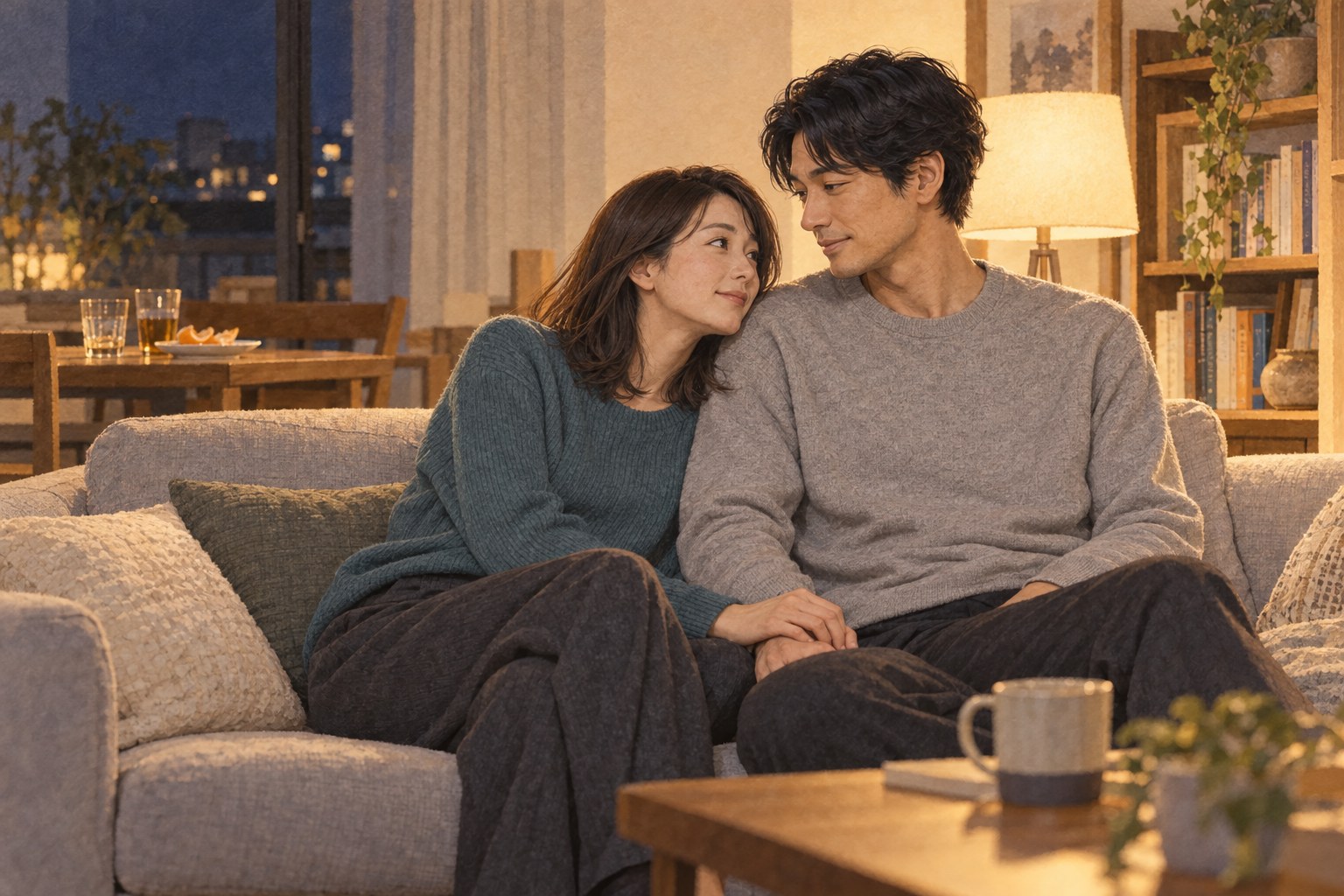
We sat together on the sofa and peeled mandarins. Ryo tore the peel into small pieces, quickly filling the little plate on his lap. I began to get up to throw them all away. His fingers touched my wrist lightly.
“Stay sitting a little longer.”
I put the plate on the table. At last, the chair I'd bought and the papers I'd cleared away no longer troubled me.
“I like you,” Ryo said.
I looked at his mouth, then his eyes.
“I like you too.”
Once I'd said it, it didn't seem enough.
“I wanted you to come today. I've been tidying up all morning.”
Without laughing, he took my hand.
“Can I come again?”
“Yes.”
“I want us to be together. From now on, too.”
At last, I could nod. When I touched his shoulder, his sweater was a little rough. His face drew close, and I closed my eyes. Even after our lips parted, I couldn't immediately take my hand away.
Ryo took out his phone to check when he needed to leave. It was still early for the last train. I looked at the time on the screen, then at him.
“Stay another half hour.”
After I said it, I worried I'd put him in a difficult position, but Ryo set his bag back on the floor. As we sat down again on the sofa, this time I moved closer to him.
I needed to ask properly where he would move in the spring. That night, I only wanted him close.
Chapter 5: The Notice Given Out First
At the end of the year, the workshop floor felt cold underfoot when I opened the door. We had plans to eat nearby after his last workday of the year. Ryo was speaking with his final customer; when he noticed me, he gestured for me to wait a little longer.
I looked at the shelf by the entrance. Beside small plates made from scraps of wood was a stack of printed notices. A new address, beginning in April. Under it, the notice said the shop would close for the latter half of March for the move.
When I took one, the paper still curled slightly. It was there that I learned the exact name of the new town for the first time. The customer put a notice into their bag and said they were looking forward to going all that way to pick up a chair. Ryo smiled and said it was surprisingly close by car. I returned the sheet to the shelf. Its edges didn't line up with the others, so I pressed them twice with my fingers.
When the door closed, Ryo turned toward me.
“Sorry to keep you waiting. Are you hungry?”
“You've decided to move.”
The look of someone getting ready to go home vanished from his face.
“Ah, yes. I signed the lease on Monday.”
It was Saturday. We'd been in touch during the days in between. I'd sent him a message about the sweets I'd received at my company's year-end gathering. He'd replied that he'd cleaned the workshop windows.
“I hadn't told you, had I?” Ryo moved the mug on his workbench toward the edge. “I thought I'd tell you when we saw each other today.”
“I see,” I said. The previous Sunday, he'd eaten breakfast with me in my apartment. I'd been glad to hear his voice when he'd just woken up. We'd run short of milk, so we'd both drunk our coffee black. I checked the sequence in my mind: the decision had come after that.
“Are you renting a place to live there too?”
“The floor above the workshop is empty. It's cheaper than renting somewhere else, so I'll take that.”
“You've decided already?”
“Yes.”
At the end of the workbench was a floor plan that seemed to be for the new room. It was a little too much to hear all at once. I stood holding my gloves in both hands instead of putting them in my bag.
“Things won't change that much when spring comes,” he said. “It's only a little over an hour. If you come on Sundays, I'll make it so you can stay over.”
“I'm the one who goes?”
“Of course I'll come here too.”
Only then did he look properly at my face.
“Are you angry about something?”
“I think I am.”
Though I'd said it plainly, my voice sounded uncertain.
“You didn't want me to go?”
“I don't like that you'll be farther away.”
After I said it, I straightened the fingers of my gloves one by one.
“But that's not the same as saying I want you to give it up.”
“You said before that you thought it was good.”
“I said having a bigger workspace would be good.”
Ryo fell silent. Even I thought it unfair to bring up such a fine distinction now. I was the one who hadn't said the rest at the time. Even so, I hadn't wanted to learn about it from a notice handed out to customers.
“Why didn't you tell me on Monday?”
“Because the details weren't settled yet.”
“How much has to be settled before you tell me?”
He lowered the hand he'd been reaching for his coat.
“Do I have to consult you every time I make a decision about work?”
I looked up. As soon as he'd said it, Ryo opened his mouth to say that wasn't what he meant. But before I could hear the rest, I answered.
“I don't even know if I want you to consult me. But I wish you'd at least told me what you'd decided.”
Someone carrying shopping bags passed outside the workshop. Thinking they might have looked in, I lowered my voice.
“You do want us to keep seeing each other, don't you?”
“Of course.”
“I want you to talk to me in a way that lets me know that.”
Ryo pulled out a chair. He suggested we sit down and talk, but I couldn't sit. That chair was for people who came to the shop for consultations. I felt that once I sat, he would explain things again and I would say I understood. I didn't know whether that was really what would happen. But at that moment, I hated the thought of myself saying I understood.
“I think I'll skip dinner today.”
“Aya.”
Just hearing him call my name made me want to stay. I'd eaten a light lunch so I could have dinner with him. I'd even chosen comfortable shoes because I wanted to go to his favorite place. If I told him all that now, I thought I'd cry.
“I'll go home and think for a bit.”
Ryo said he understood. When I opened the door and went outside, he didn't follow me. I would have been troubled if he had, but I looked back once before turning the corner.
On the train home, I remembered the apartment I'd shared with my former partner. It wasn't that I'd lived just as he'd told me to. I was the one who'd said I'd match his dinner schedule, and I'd told him over and over that I didn't mind when he was late. In the end, I became unable to say when I did mind. When we parted, he said he wished I'd told him sooner. I had thought I had been telling him.
Ryo messaged: Let me know when you get home. Once I arrived, I replied: I'm home. His next message said he hadn't spoken well today. I read it several times. Was the way he'd spoken the only thing that was wrong? I typed that, then deleted it.
If I called, I could still hear his voice. Even so, I set down my phone and took rice from the freezer. The two minutes it took to heat felt longer than usual.
Chapter 6: Things We Haven't Decided Yet
On the second day of the new year, I went to my mother's apartment. A length of black cloth lay spread over the end of her table. I asked if she was working even though the shop was closed. She said she was about to mend the hem of her own trousers.
“I do other people's right away, though.”
She cut the thread and put her tools in a box. I set down the sushi I'd brought. Before opening the lid, she looked at my face.
“Are you tired?”
“A little short on sleep.”
“Are you staying tonight?”
“I'm going home.”
My mother nodded and took out two teacups. She didn't ask why I was going home.
Ryo and I had agreed to meet on the afternoon of the fourth. That night, I'd fallen asleep without answering anything, and had contacted him the following morning. It had taken twenty minutes to write that I wanted us to talk properly. He'd replied that he wanted to talk too. When he asked where, I'd chosen my apartment. Perhaps it would be better to meet outside if we were going to break up. But I couldn't decide for myself that I was asking him over in order to end things.
My mother poured soy sauce into little dishes. I took one and told her I'd been seeing Ryo. She stopped with her chopsticks in her hand.
“The one who fixed the chairs?”
“Yes.”
“Oh.”
She immediately started to say she was happy for me, then looked at my face and closed her mouth.
“We're having a bit of a fight right now.”
“I see.”
“That's all?”
“What should I say?”
I laughed a little. My mother took a piece of egg sushi, ate half, then said, “I'm glad we didn't put the sushi in the refrigerator. The rice gets hard.”
I couldn't tell whether she was changing the subject for me or really thinking about the sushi. I ate a piece of shrimp.
On the fourth, Ryo arrived at the agreed time. When I saw his face at the door, the first thing I felt was that I'd missed him. Annoyed with myself for it, I went straight to the kitchen. While the water heated, he stood there without taking off his coat.
“You can hang it up,” I said. Only then did he take it off.
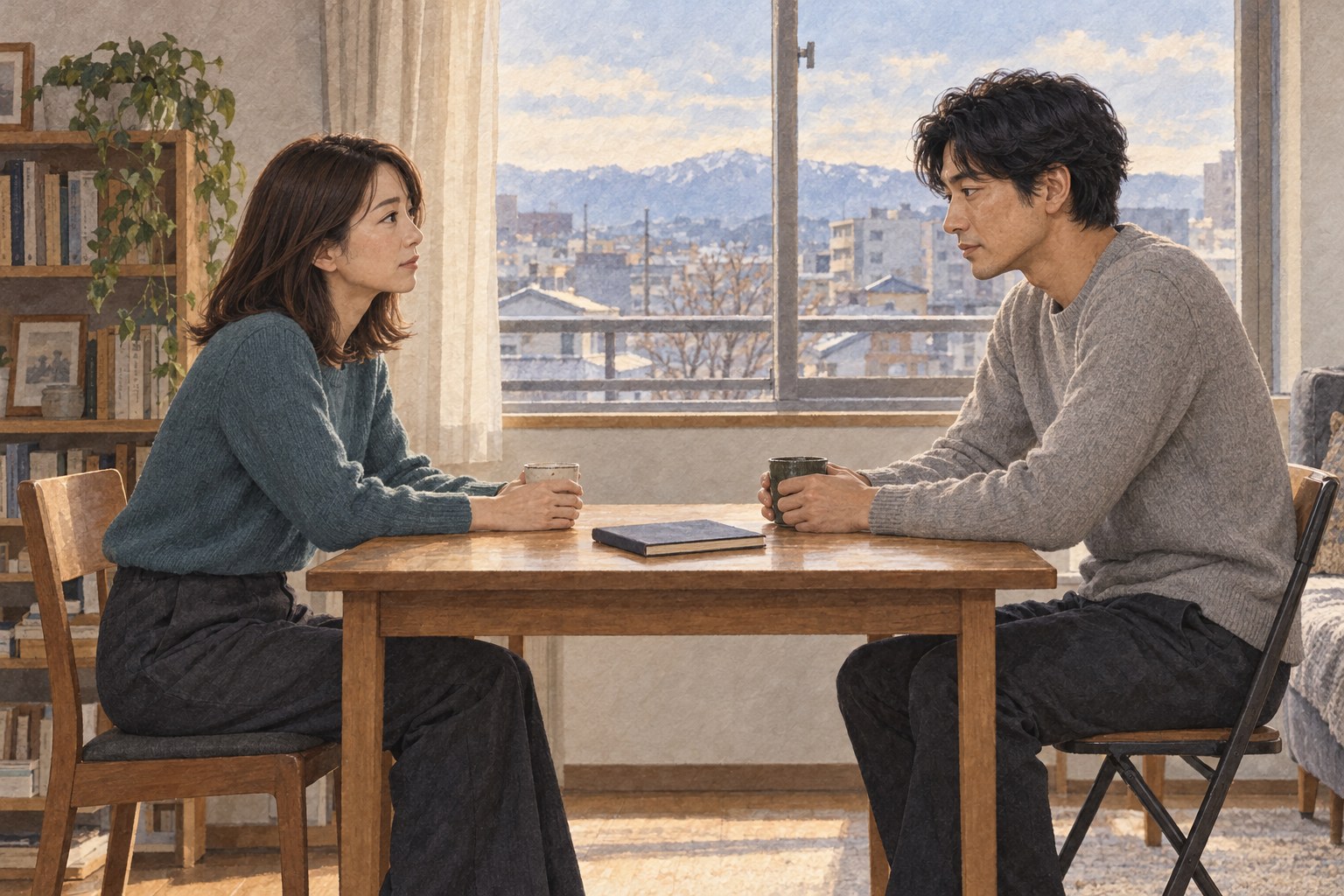
I left the table empty. He sat on the folding chair he'd used before. I put out glasses and sat opposite him. Ryo started to take a floor plan out of his bag, then stopped.
“First, I wanted to apologize.”
I nodded.
“I don't think it's just a matter of telling you before anyone else. I said we'd be fine without really thinking about how we'd see each other after I moved.”
He lowered his hands to his knees.
“I was happy my work was going to grow, and thought we'd work the rest out somehow.”
He probably hadn't noticed that I was among the people expected to work it out. I wanted to say that, but waited a little.
“I once told someone I lived with before about my plans to go independent,” Ryo went on. “They told me to do as I pleased, and after that I stopped asking them anything. I don't think I wanted to be opposed.”
“What did they think about it?”
“I don't know. I never asked.”
If this had been a story about his former partner being cold, I wouldn't have wanted to hear it. Ryo left it there. After a while, I spoke.
“I should have said I didn't like that you'd be farther away, too.”
He looked up.
“I wanted to be someone who could support you properly. I thought it was childish to hate that we wouldn't be able to see each other.”
“That's not—”
“I know. You're not the one who said it to me.”
I didn't want to get that wrong.
I held the cup I'd filled too high with hot water in both hands. It was hot, so I put it down right away.
“When I fall in love, I feel like I can adjust to the other person. At first, that makes me happy.”
I went on, looking at the grain of the table.
“But I don't think I can travel there every week. I want to see my mother too, and I want days when I do nothing by myself.”
“Yeah.”
“And I don't want you to think that means I don't want to see you.”
My voice caught a little at the end. Ryo didn't hurry to answer. When I looked up, he was watching me.
“I'll come here. But I can't promise right now that I can come every week.”
It was the first inconvenient answer I'd heard from him.
“In March, work and the move will overlap. Things probably won't settle down in early April either.”
I nodded.
“Even so, I want to see you. I want to keep being with you, Aya.”
Only after hearing that did I finally take my hands off the cup.
We didn't settle every plan then and there. I had work the following week, and he had a delivery the week after. We looked at our planners together and chose the last Sunday in January. He would show me the new workshop. When we looked up the address, it turned out to be nearly an hour and a half from my apartment. The little over an hour he'd mentioned was from his current workshop.
“It's not close.”
“No. It wasn't close.”
Ryo answered without looking away from the screen.
Before leaving, he stood beside me. I could tell he wanted to touch me. I took his hand. I was still a little angry. It wasn't that I'd fallen in love with him again; I'd loved him all the time we were apart. I traced the base of his finger once with my thumb.
“Can we leave it here for today?”
Ryo nodded. It took a little while before we let go of each other's hands.
Chapter 7: A Station I'd Never Got Off At
On the day we'd arranged to meet, the train stopped for a while along the way. I messaged Ryo from my seat. He replied that there was no need to hurry, then sent the name of a place in front of the station where he'd be waiting.
When I came through the ticket gates, the unfamiliar town had a smell of its own. I couldn't see the sea. Low clouds lay one over another beyond the sloping street.
Through the shop window I saw Ryo holding a warm drink in both hands. When he noticed me, he set down his cup and began to rise. I waved from outside. I meant that he didn't have to come to the entrance. But he came anyway.
“Were you cold?”
“It was hot on the train.”
I took off my scarf. Ryo looked at my face, then led me to the seat he'd been at. An empty chair had been left there for my coat.
The workshop was about a fifteen-minute walk from the station. At a bakery on the corner, we bought something for lunch. Ryo chose two round rolls and started to put them into my bag, then stopped.
“Are you taking them home?”
“I'll eat one. Is the other one yours?”
“I'd meant it for tomorrow morning.”
We each carried our own bag. On the way uphill, he slowed his pace. I stopped trying to hide that I was out of breath.
“You walk up here every day?”
“On days I don't go to the station, I don't think I'll go down.”
“Because you'd have to climb back up.”
He laughed.
The new workshop occupied half a converted warehouse. The master craftsman working next door was out today, he said. Ryo turned the key and pushed open the heavy door.
There were no machines inside yet, and our footsteps echoed. Lumber leaned against a wall, and protective paper still covered parts of the floor. It looked more than twice the size of his present workshop.
“The workbench will go here, and the machines in the back.”
Ryo pointed as he walked. His voice was a little higher than it had been on the phone. I followed behind him.
He unfolded a drawing that had been propped against the wall. It was an order for a long storage cabinet. In his current workshop, he said, it was so large he would have to make it in several separate stages.
Partway through his explanation of the dimensions, I lost track. But I wanted to watch the movement of his fingers and his profile as he checked things while he spoke. I still knew so little of what this person looked like doing something he loved.
“Sorry. I'm going on too long.” Ryo folded the drawing.
“I don't understand all of it, but I'm listening.”
“How much did you understand?”
“That here, you won't have to take it apart halfway through.”
“Right. That's a big thing.”
He nodded, looking pleased. I felt a little lonely. He had more than enough reasons to want to come here without me. At the same time, I had a feeling that if he hadn't had those reasons, I wouldn't have fallen for him.
We went upstairs to the room. The kitchen was small, and the roof of the neighboring building was visible through the window. When I said I'd thought there might be a view of the sea, Ryo stretched up a little.
“You should be able to see it between those buildings.”
I stood in the same spot. There was a thin strip of blue. At first I couldn't tell whether it was sky or sea.
“We'll have to look again on a clear day,” I said.
He turned from the window to look at me. A moment later, I realized I'd said I'd come again.
We switched on the small heater he'd brought and ate the bread. There were no chairs yet, so we laid a folded blanket on the floor. The electric kettle's cord was short, and each time the water boiled Ryo got up. The first time I tried to help; the second time I stayed where I was and waited.
In a room I didn't know, he was making tea for me. I liked the time I spent watching him more than I'd expected.
I'd looked up a train home before five. As I started to get up to tidy, Ryo glanced at the clock.
“Are you leaving already?”
“That was the plan.”
I waited for his answer. He folded the bread bag in his lap.
“Would you like to see the sea in the evening before you go?”
“Is it the sea you want to see?”
The question surprised even me. Ryo looked at me.
“I want to spend a little more time with you.”
Only when he said it did I realize that was what I'd wanted to hear.
I could still get home at a reasonable hour on the next train. I checked the connection once and put my phone back in my bag.
“Then, just one hour.”
Ryo said yes. I touched his hand. I managed not to ask him to stay where he was instead of moving the workshop. But I thought there would be days when I felt lonely. I didn't want to decide today that I would be fine, even on those days.
The wind was strong by the sea, and we couldn't talk for long. When I caught hold of the back of his jacket, he turned around. I laughed, and he laughed too. His face looked much closer than it had on the day we'd talked everything through.
On the way back to the station, I was the one who put my arm through his. I'd thought it was tiresome to keep checking, over and over, that I loved him. But today I wanted him to know.
Before the ticket gates, Ryo touched my cheek. His fingers had hesitated just before touching me, and I held them there with my own hand. We kissed briefly, then drew apart. Someone passed, so we stepped a little to the side. Embarrassed, I took out my house key instead of my ticket. Ryo laughed.
“Next time, I'll come to you.”
“Okay. Let's decide the date later.”
After I went through the gates, I looked back. He was still standing there. I waved once more. On the train home, I looked for the name of the station where I'd got off for the first time on the route map.
Chapter 8: The Sound of a Chair Being Pulled Out
On the second Saturday in April, Ryo was coming to my apartment. He'd finished moving the workshop at the end of March. In the meantime, we'd only managed to see each other twice. Once, my work had run late, and we'd had tea for about an hour before parting. Ryo said he'd wanted to see me, too. I answered, “I'm sorry,” and then corrected myself: “Me too.”
On Saturday morning, I stopped by my mother's apartment to collect the coat she'd mended for me. A bright cloth covered her dining table, unlike anything we'd had in our old home. The sewing machine had been moved to one side, leaving room to open the box of sweets I'd brought.
“Has Mr. Mano moved?”
“Yes. He's working over there now.”
“He's farther away.”
“He is.”
That was enough for her; she nodded. She didn't count the days I'd go to see him or ask which of us would make the trip. Instead, she told me she'd tightened one of the coat buttons too. I put it on and straightened the collar.
“Are you seeing him today?” she asked.
“This evening.”
“Then maybe you should have a light lunch.”
“I'm hungry now. I want a normal lunch.”
Mother smiled a little and opened the refrigerator. We ate udon together. Someone from the shop was coming by that afternoon, so I cleared the dishes and went home. At the door, Mother said Mr. Mano should come for tea sometime too.
“I'll ask him,” I said. We didn't decide on a day then and there.
Back in my room, I turned the dining table. Instead of putting its long side along the wall, I placed only a short end against the wall by the window. With the chairs facing one another, the way to the balcony became a little narrower. I walked through and decided it was all right.
My usual chair and the folding chair I'd bought in December were slightly different heights, so I put a thin cushion on the lower one.
Just after three, Ryo called. Delivery of the machine for the workshop had been delayed, and he couldn't come at five. It would be after eight at the earliest.
“Go ahead and eat.”
I moved the onion from the cutting board back onto a plate.
“Is it too much for you to come?”
“I want to come because I want to see you. But if you'd rather I didn't come so late, we can make it tomorrow.”
I had plans tomorrow too—not at Mother's, but a friend's concert.
“Come today. I'll eat dinner first.”
“Okay. I'll let you know when I know what time I can leave.”
After hanging up, I changed what I'd planned to cook. For myself, I made yakisoba with the vegetables I had left. I wondered whether to make some for Ryo too, and asked him. He replied that he'd buy a boxed meal at the station.
At six thirty, I ate alone. After washing the plate, I ordered a small bouquet to take with me the next day. I folded the laundry and read a few pages of a book. Partway through, I checked the clock. It wasn't that I wasn't waiting. I was using the time until he arrived for myself, too. Even so, when the doorbell rang, I closed my book at once.
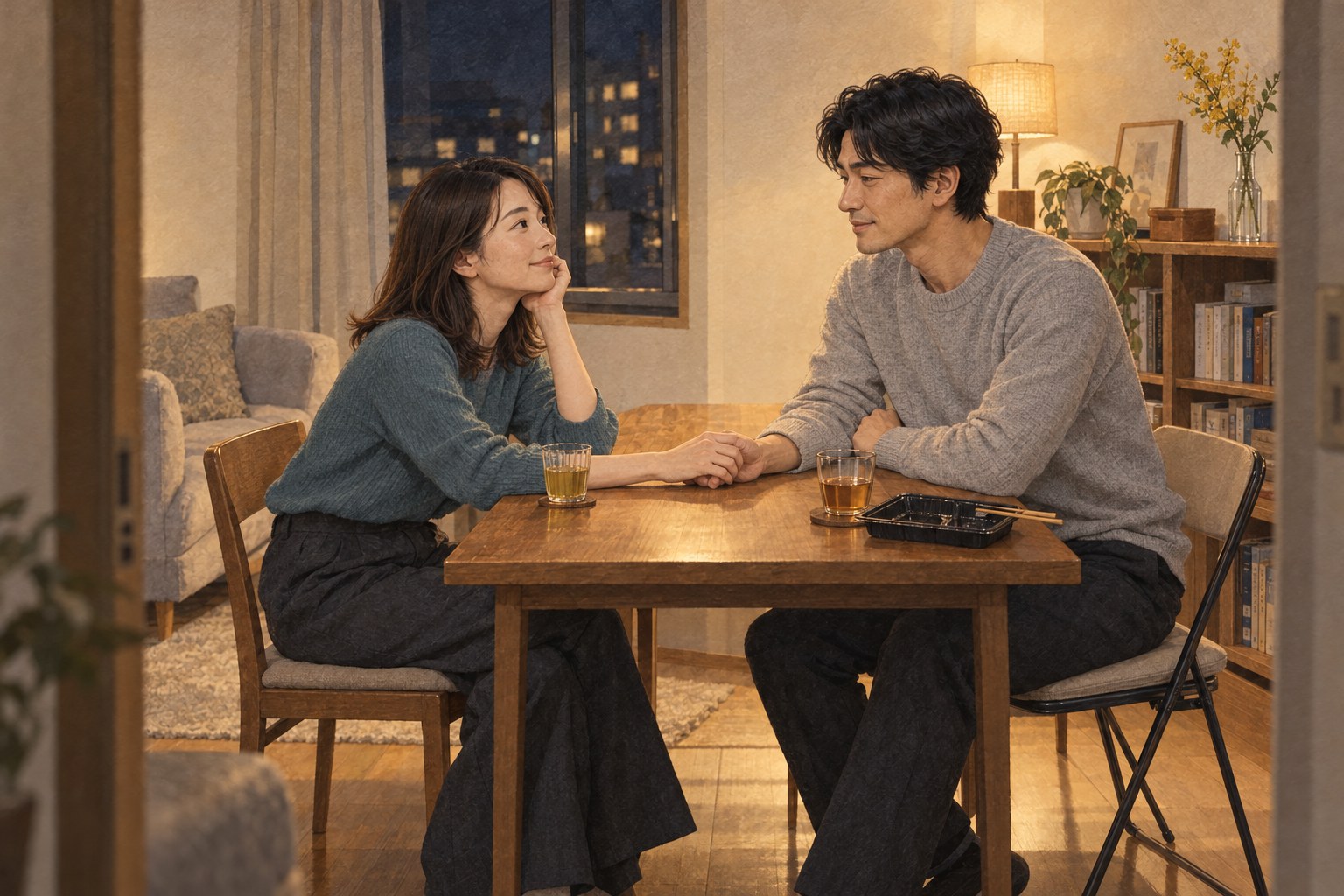
He brought a boxed meal and a single stem of yellow flowers, which he'd found at the florist in front of the station. When I removed the thin wrapping paper, a number of little blossoms were lined along it.
“I asked what it was called, but I forgot.”
“Then let's look it up later.”
I put it in a narrow bottle on the shelf. On the dining table, it looked as though it would get in the way of opening his meal.
Ryo washed his hands, came back into the room, and stopped in front of the table.
“You turned it.”
“I'm trying it this way to see if it's easier to sit at.”
He pulled out the folding chair, adjusted the cushion, and sat down.
“This is nice too.”
I sat across from him.
There was grilled fish in his boxed meal. Ryo took off the lid and carefully folded the wrapper from his disposable chopsticks. When I asked if work had been hard, he immediately said it had. I laughed. He laughed too, then told me how they'd finally managed to get the machine through the entrance. As he talked, he stopped eating.
“You can tell me after you've eaten.”
“Yeah. I'm hungry.”
I made fresh tea.
When he'd finished eating, Ryo leaned back in his chair for a while. I looked at him, wondering if he was sleepy, and our eyes met.
“What?”
“I was thinking I hadn't really looked at your face, Aya.”
I started to lift my glass, then stopped. I wanted to say something back, but couldn't think of anything clever.
“I wanted to see you too.”
That was all I said. Ryo held out his hand across the table. I placed mine over it.
I still didn't have a key to his room. He didn't keep any clothes at mine, either. Tonight he would stay over; tomorrow morning he would go back to the workshop. I would go to the concert. Morning would come when we'd leave the same place for different destinations. Before that, I wanted us to have breakfast together.
“Would bread be okay tomorrow?” I asked. Ryo nodded.
“Shall I fry some eggs?”
“Then I'll make coffee.”
I'd bought milk that morning. I thought about telling him, then left it for later. With our hands together, I couldn't clear away the empty meal box. I left them as they were a little longer.
When Ryo stood, the chair legs made a small sound. He carried the box to the kitchen, and I wiped the table. Tomorrow we'd sit across from each other here again. Even with two glasses set upside down, there was room for our breakfast plates.
I hung up the dishcloth and came back to find Ryo looking at me. I went to stand beside him. This time, I didn't have to check when it was time to go home.
夏凪 伊織
Your chapter is saved only in this browser on this device. No account is needed and your reading position is never sent. Progress is kept for up to 20 works, for 180 days after the last save.