NOVEL
Novel “Beyond the Rain” #L1
About 30 min read
Published:
Your reading progress
Progress is saved only in this browser on this device.
Chapter 1: The Forgotten Umbrella
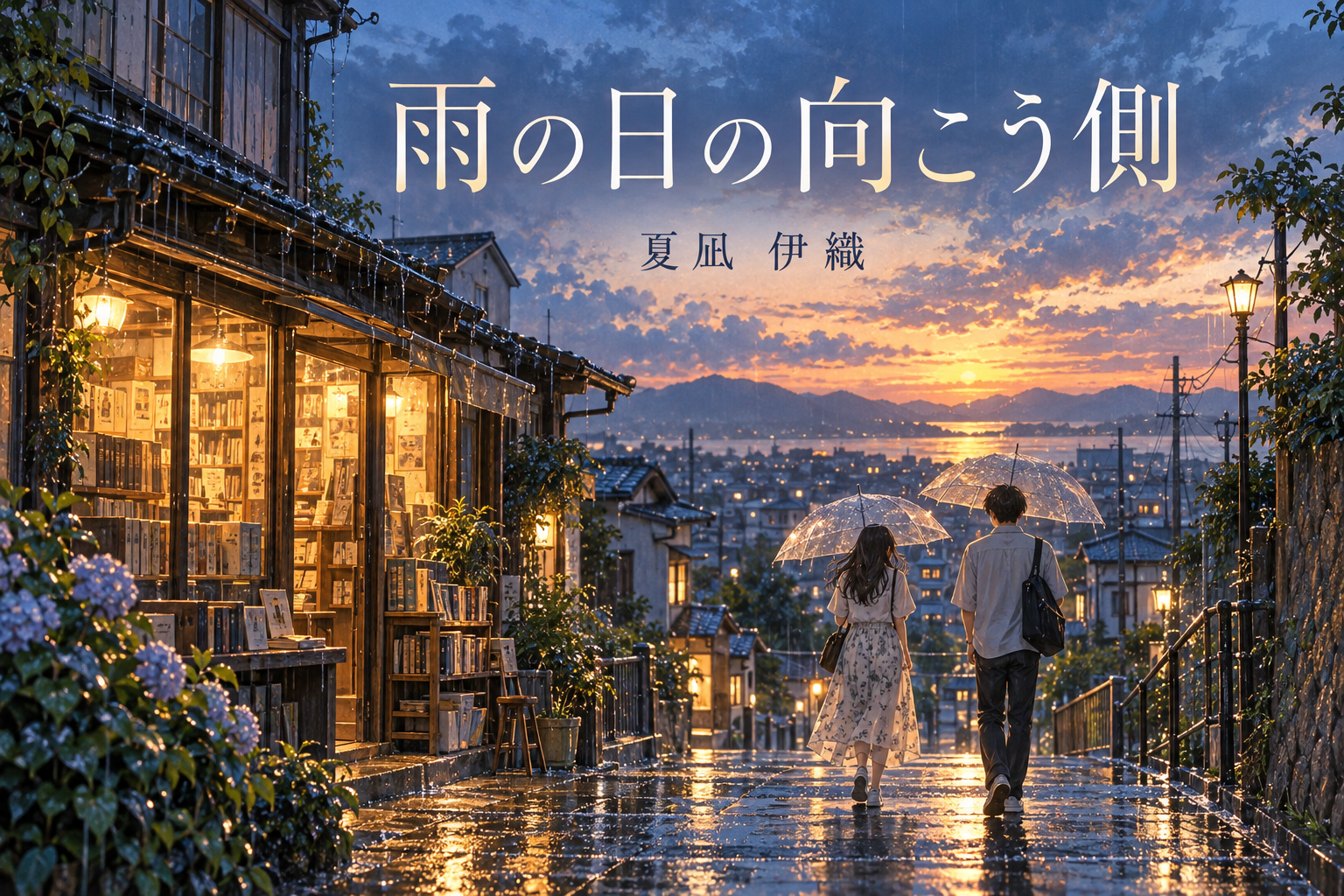
I thought I had chosen the wrong place to get out of the rain.
I had barely stepped into the secondhand bookshop when someone handed me a cleaning rag.
A young man who worked there was holding an armful of paperbacks from the stack beside the entrance.
Rain was bouncing off the awning, almost reaching the box at the bottom.
“Could you wipe that chair for me?”
“I’m a customer, you know.”
“Sorry.
In that case, dear customer, would you mind?”
Changing the way he asked didn’t exactly solve the problem.
Thinking this, I wiped the seat of the round stool.
August 3.
It had been sunny until earlier that day, but the rain started the moment I set off from the station.
In my bag were pieces of work I had handed in at college and just got back.
My umbrella was by the front door at home.
I could remember perfectly well that I had meant to take it when I left.
The young man put the books down and looked at my bag.
“Got paper in there? I’ve got a bag you can use.”
The large bag he brought from the back had FIFTY GYOZA printed on it in thick letters.
“My work goes in this?”
“Don’t like it?”
“I haven’t got fifty pieces.”
“Plenty of room, then.”
When I laughed, water dripped from my wet fringe.
A woman on the phone at the back of the shop gave me a little nod.
I had bought books here a few times before.
She was Chiyo, the owner.
I had never met the young man.
“This is my grandson, Ritsu.
He’s home for the summer holidays.
You must be about the same age, Mio?”
“I’m nineteen.”
“Me too.
I turn twenty at the end of October.”
“November for me.”
It was only a month or so, but I felt as though I had lost to him, just a little.
The shop was called Tsubame Books.
It stood one street back from the road along the river.
It wasn’t a shortcut, but I often walked past.
I liked looking at the handwritten price tags and the shelf labels that changed each month.
“Mio studies design at a vocational college, you know.”
As Chiyo said this, I folded down the top of the bag.
It was already the summer of my second year, and I still couldn’t give a proper answer when people asked what I wanted to make.
I was good at taking what someone asked for and arranging it neatly.
But with my own work, I could spend forever trying to settle on the first page.
Beside the till was a flyer for this year’s secondhand book fair.
It seemed to be a small event in the shop’s courtyard, where people from the neighbourhood would each bring a box of books to sell.
The date was September 7.
As I read it, Chiyo spoke.
“I’d like to try making a little guide this year.
Introductions to the people selling books, a map to the shop, that sort of thing.
I’m looking for someone who could do it.”
I turned the flyer over.
A sheet folded in half would leave room to jot down thoughts on the way home.
For the sellers’ introductions, it might be interesting to have everyone answer the same questions.
When I said as much, Chiyo offered me a chair.
“Could I commission you to do it? There isn’t much in the budget, but we can talk about an estimate.”
The gyoza bag rustled in my lap.
This was different from a college assignment.
The people at the shop would actually use what I made.
I glanced at the rain falling outside the entrance.
Then I said, “I can do it.”
Ritsu brought over some cold barley tea.
“I’ll help with the interviews.
Just minding the shop makes me sleepy.”
“Is that something you say in front of the client?”
“She’s my grandmother, so it’s fine.”
“Your grandmother can still hear you.”
Chiyo spoke without stopping her tapping on the calculator.
By the time the rain eased, we had settled on the paper size and the number of pages.
Fifteen minutes to get home.
I thought I could probably run it, but Ritsu pulled a navy-blue umbrella from beside a shelf.
“Borrow this.
You can bring it back next time.”
A piece of white vinyl tape on the handle bore the small word SHOP.
I took hold of it and decided when I would come back.
Chapter 2: A Reason to Meet on a Sunny Day
Eight pages, one hundred copies.
I would be paid a design fee, separate from the printing costs.
I had a teacher at college check the format of my estimate, and when I brought it in, Chiyo adjusted her glasses and read it carefully.
Beside her, Ritsu was sticking price labels to his fingers.
“So you’re a hundred yen.”
“I was three hundred a minute ago.”
“What happened?”
“I wish I knew.”
When I was with him, I didn’t have to try to say anything sensible.
It was sunny on our first day of interviews.
We went around the shopping street together, talking to the people who would be selling at the book fair.
The baker said they were bringing books about fishing, not cooking.
The florist apparently owned nothing but books of scary stories.
There were so many things I didn’t know, all within walking distance of home.
Ritsu was a good listener.
He didn’t rush to sum up what someone had said, but waited a little before asking his next question.
He told me he was studying architecture at university.
“Do you like Tokyo?”
“Some days.
Like when I manage to change trains properly.”
“You’ve been there more than a year, haven’t you?”
“I think they keep adding lines.”
When I laughed, he laughed too.
But when we started talking about his architecture assignments, his voice grew a little quieter.
“Everyone’s seen so much.
They’ll just casually start talking about buildings I’ve never heard of.”
While I was wondering how to answer, the lights changed.
As we crossed the road, I held out the little bag of rusks the baker had given us.
“It’s the same for me with typefaces.
I pretend I know them, then look them up when I get home.”
“I bet you’re good at that knowing look.”
“That was rude, you know.”
“Sorry.
I thought I’d start by learning the look.”
Ritsu took a bite of a rusk, leaving fine crumbs at the corner of his mouth.
I didn’t quite want to tell him, so I watched in silence for about three seconds.
It started raining halfway through our second round of interviews.
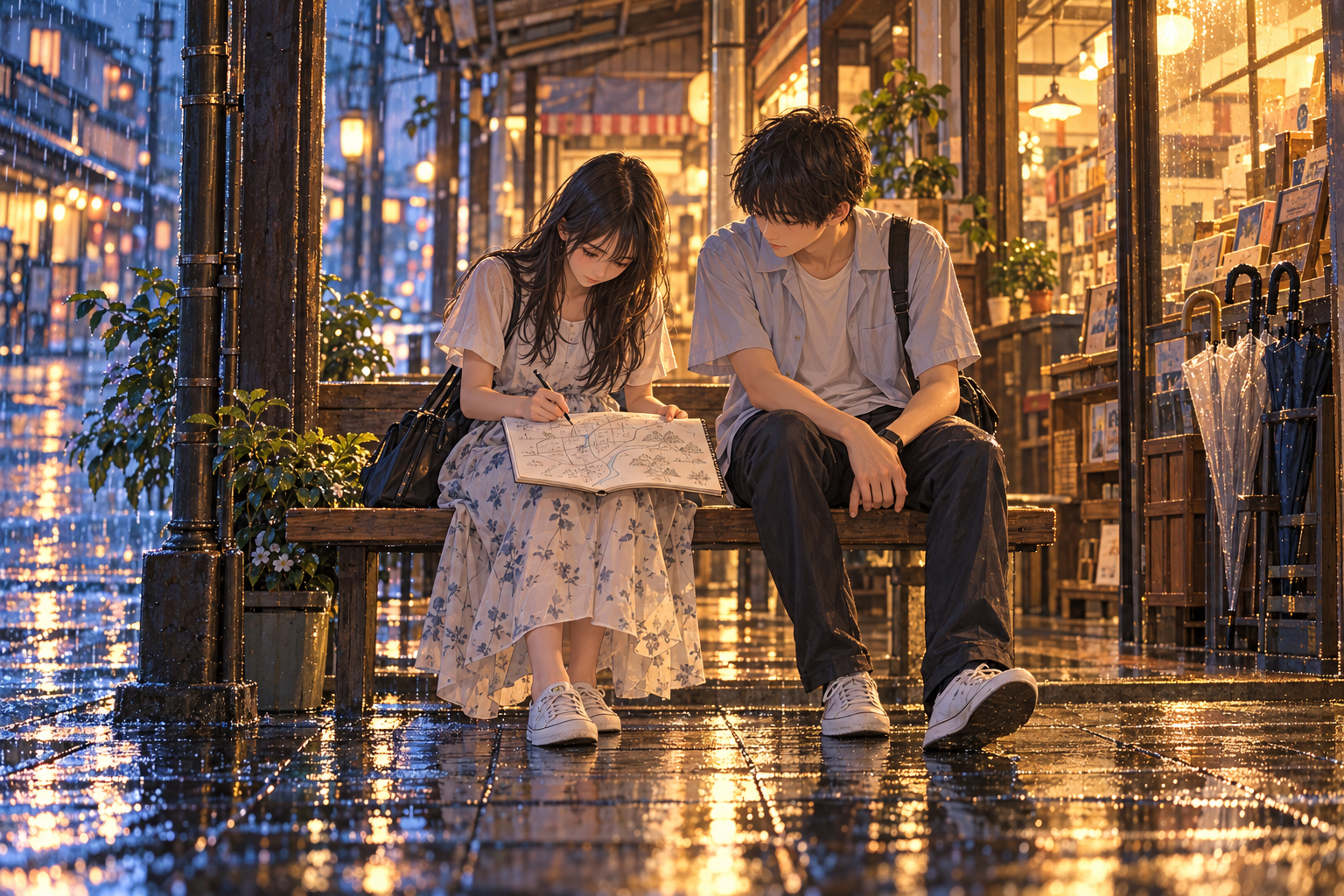
We gave up on taking photographs by the river and took shelter in an old covered shopping arcade.
Looking at the map, Ritsu said we could get back to the shop this way.
“Isn’t that the long way round?”
“There’s a roof the whole way.
Except for the last fifty metres.”
As we walked, we found public toilets just around the corner, and benches along the way.
Some people coming to the book fair would be making their way from the station for the first time.
Instead of showing only the shortest route, it would be better to include one that was easier to walk in the rain.
I sat on a bench and revised my rough map.
Beside me, Ritsu was shaking the water off the toes of his shoes.
“I’d like a copy of that map.”
“What would you use it for?
This is your hometown.”
“Sometimes I come back and there’s a different shop where I remember something else.”
My pencil stopped.
Ritsu was coming back to this town.
I lived here.
For the first time, I understood a little of the difference.
“How long are you staying?”
“Until September 8.
The day after the book fair.”
The answer came straight away.
I thought knowing might help me handle it a little better.
Knowing there would be a day we said goodbye, and what I should talk to him about before then.
But the next day, I checked the weather forecast three times for no reason.
Would the shop be quieter if it rained?
If I finished my work early, would we have a little longer to talk?
I had returned the borrowed umbrella at our first planning meeting.
I wished I hadn’t, then felt a little exasperated at my own scheming.
I still had reasons to see him.
And yet I wanted to be someone who didn’t need one.
Chapter 3: A Place for My Name
By the end of August, the first mock-up of the booklet was ready.
After closing time, Ritsu spread the pages out on the round table.
Each time he turned a page, I watched his face.
Was the type too small?
Were the photographs too dark?
Which page would make him pause?
“I like this.”
Ritsu was pointing to something the florist had said.
“I like scary books because you don’t have to read them while it’s still light.
You can’t say the same for tending flowers.”
“I was there when they said that, but I’d forgotten.”
“I listened to the recording over and over.”
“You find things like that, Mio.”
It wasn’t the first time he had said my name.
But this time it felt as if there were something of me in the words that followed, and I took a moment to answer.
“You helped with the interviews too.”
“I make too much noise agreeing with people.
I must have got in the way on the recording.”
“Yes.
Quite a lot.”
“You’re supposed to disagree.”
I laughed and opened the last page.
The imprint listed only the shop’s name and contact details.
“Where’s your name?”
“I thought maybe I didn’t need it.”
“Why not?”
I wanted praise, yet I was making sure no one could tell who had made it.
His question made me realise I had been leaving myself a hiding place in case I failed.
“I’ll put it in.
In small type.”
“Big enough to read, please.”
Air from the air conditioner lifted the edge of a thin sheet of paper.
Ritsu held it down with his hand.
There was a trace of white glue beside one of his nails.
Apparently, he was still working on his university projects while he was home, building models at night.
“I’d like to see something.
Something you’ve made.”
After a little hesitation, he took out his phone.
The photograph showed a model of a small square in front of a station.
There were several benches under a roof.
“An assignment from June.
They said I’d put too many seats where people needed to walk.”
“I thought it looked like somewhere you could sit down.”
“Yeah.
That was what I wanted.”
The way he said it stayed with me.
Ritsu showed me another photograph.
One of the columns supporting the roof was bent.
He said it had broken while he was carrying it.
I zoomed in and looked at it for a while.
Everything else was so precise that this one place made me oddly aware of the hands that had made it.
“Didn’t you fix it?”
“I only had seven minutes before the presentation.”
“With seven minutes, I’d pray.”
“I did.
Architecture’s hard.”
We laughed across the table, then said nothing for a while.
I felt as though I didn’t have to go home, even when there was no task to fill the silence.
As I started putting things away, Ritsu rested a hand on the edge of the table.
“Going already?”
“Am I in the way if I stay?”
“The opposite.
I want to talk a little longer.”
I put my pencil case back on the table, though I had already zipped it shut.
Ritsu started to say something, then ended up asking which club I had belonged to in high school.
I was so happy at his roundabout way of keeping me there that I even told him about the broadcasting club, which I hadn’t belonged to.
My phone vibrated.
It was Akane, a friend from college, messaging about the application assignment for a printing company in our prefecture.
I hadn’t decided whether to apply.
The assignment was “a booklet introducing a place close to home.”
The deadline was September 10, and I could submit the book-fair guide if I got the shop’s permission.
But I wanted to include something I had made entirely on my own.
I wanted to start by deciding what to put in it, rather than just arranging material already chosen for me.
“A job application?” Ritsu asked.
“Yeah.
I’ll be working by next spring.”
Saying it aloud suddenly made it real.
Ritsu still had more than two years of university ahead of him.
I had next month’s application, and beyond that, rent and commuting costs.
We were both nineteen, but things weren’t going to happen in the same order for us.
“What are you making?”
“I don’t know yet.
That’s the part I can’t decide.”
“I’d like to see it when it’s done.”
I nodded.
What I really wanted to say was, Stay here until I finish it.
Chapter 4: Even When It’s Sunny
Once September began, Ritsu started messaging me more often.
“What colour would make the price tags easiest to read?”
“Do you think six chairs will be enough?”
“Grandma’s peeled some pear for you too.”
I answered the first two quickly and left the third for a little while.
All I would be saying was that I wanted some, but it felt as though he might read it as, I want to see you.
After classes, I went to the shop.
I made the signs they asked for too.
I edited the introductions that came in late from the sellers.
For my own booklet, the one I was submitting to the printing company, all I had to show for my work was more and more versions of the cover file.
When I mentioned it over lunch, Akane set the carton she was drinking from down on the desk.
“Aren’t you taking on too much work for the shop?”
“There’s only a little left.”
“You said that last week.”
Akane’s portfolio was carefully marked with the dates of each revision.
I didn’t much like looking at it, so I took refuge in talking about love.
“Do you think you can see someone every day and not start liking them?”
“Sure.
We see each other every day.”
“That’s not what I mean.”
“I know.”
Akane tied the straw wrapper into a little knot.
“But just because your feelings grow every day, I don’t think it means theirs grow by the same amount.”
I traced a scratch in the desk with my nail.
Even the place I had escaped to had truths I didn’t want to hear.
That evening, at Ritsu’s request, I went with him to buy fabric for the fair.
We browsed the shelves of a craft shop, comparing colours.
When the shop assistant asked, “Which do you two prefer?” the words “you two” stayed with me for a while.
It was still light outside when we finished shopping.
There was no rain symbol in the forecast.
I had brought my own umbrella, and it felt a little heavy in my bag.
“If you’ve got time, do you want to get something to eat?”
Ritsu looked at the station clock.
“Sure.
I’ve got an online meeting with some friends from university at seven, so as long as we’re done by then.”
Until seven.
Even so, I was happy.
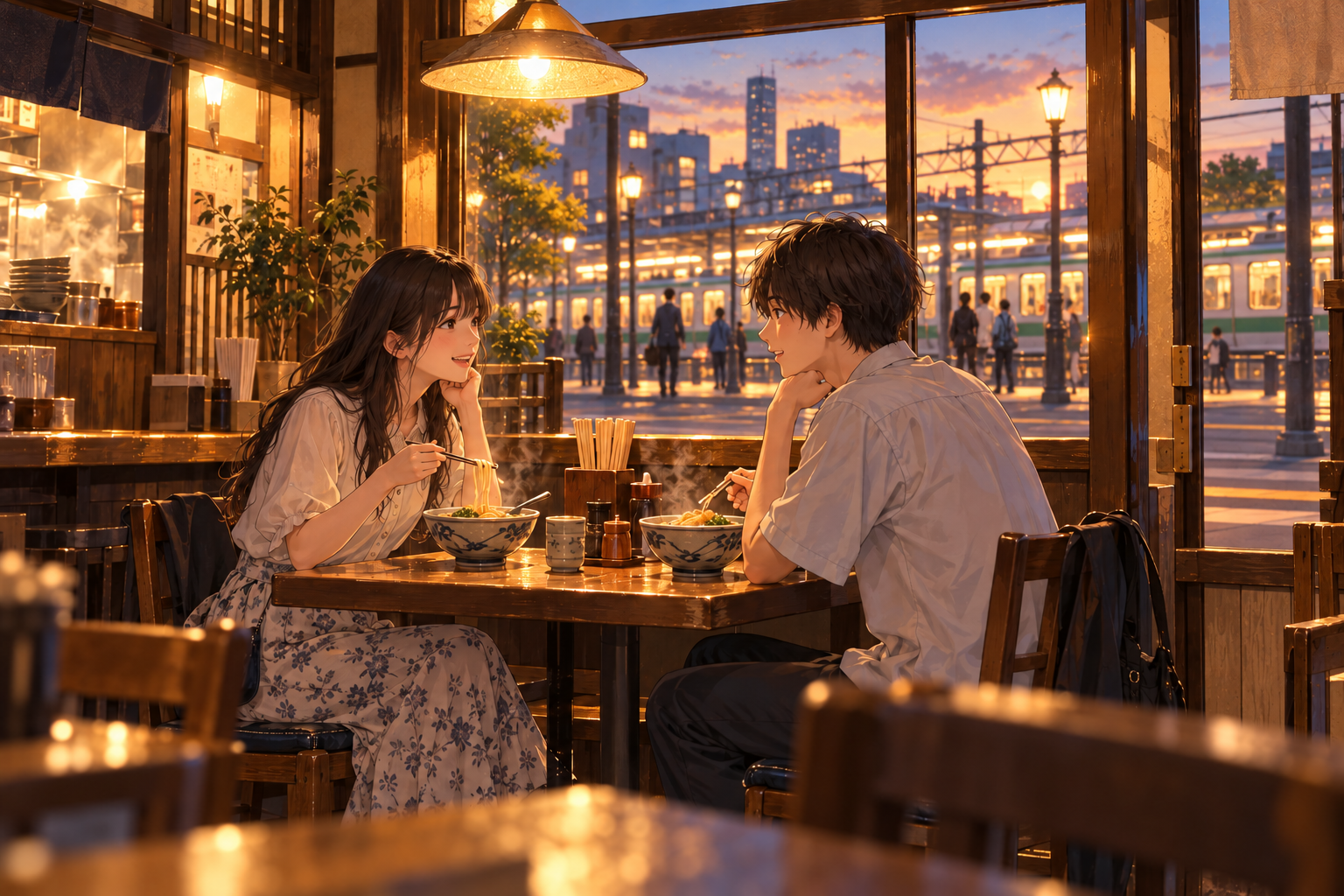
At the udon place in front of the station, Ritsu ordered a large serving of cold noodles.
I ordered the regular size, then regretted it when his bowl arrived.
Two big tempura fritters sat on top.
“You’re staring at mine.”
“I’m not.”
“Want one?”
“Yes.”
I answered so quickly that we both laughed.
Ritsu asked for a small plate and put one on it.
“Do you want to take a little walk by the river after the book fair?”
I asked as I broke up the fritter.
“After the shop closes?”
“Yeah.
Before you go back.”
Ritsu set down his bowl of dipping sauce.
“Sure.
I’ll make sure I’m packed the day before.”
We had made a plan.
That alone made me restless right to my fingertips.
I was already thinking about what to wear on the evening of September 7.
As if I could wear anything nice when I would be helping clear up after the fair.
We paid separately and left, and Ritsu carried the fabric for me.
I wanted to touch his arm.
I could do it if I pretended to straighten the edge of the fabric.
I got that far in my thoughts, then put my hands in my pockets.
Not noticing a thing, Ritsu was worrying about the plant he had left in his room in Tokyo.
Apparently, he had asked a friend to water it.
Someone I didn’t know was going into a room I had never seen.
I had already asked whether he was seeing anyone.
He had said no.
That didn’t mean there was a space waiting for me.
Still, when I remembered our plan for the seventh, I let my strides grow a little longer.
Chapter 5: A Change of Plans
Two days before the book fair, the rain forecast stopped wavering.
The printed booklets had been available in shops along the shopping street since the week before.
It was expected to rain from morning through evening.
The tents in the courtyard wouldn’t keep the books safe, so Chiyo contacted the sellers to say the fair would move indoors.
There had been a wet-weather plan from the start.
But there wasn’t room for all eight sellers’ boxes at once, so four would take the morning and four the afternoon.
The layout in the already-printed booklet still showed the courtyard.
When I suggested slipping in a correction sheet, Chiyo thanked me.
That much, I had volunteered for.
Then Ritsu set a sheet of paper on the table.
It was a drawing of the shelves inside the shop.
“Could you make this easier to read?
And a schedule, and something to put up at the entrance.
They said a list of the books would help too.”
I knew he didn’t mean any harm.
He believed I could do it.
That should have made me happy, but as I looked at the writing on the page, I suddenly found it hard to breathe.
“Today?”
“By about noon tomorrow.
We can do without the book list if it’s too much.”
I had meant to finish my own booklet the following evening.
I hadn’t even written half of the text yet.
I was the one who kept coming here, unwilling to waste any of these last few days when I could still see him.
“Handy having me around, isn’t it?”
Once I had said it, I couldn’t take it back.
Ritsu looked up.
“That’s not what I meant.”
“I know.
Ask me and I’ll usually say yes.”
Chiyo was on the phone out at the front.
Neither of us had raised our voice, yet the space around just the two of us suddenly seemed to shrink.
“If you don’t want to, just say so.”
At his words, I tried to smile.
I couldn’t quite manage it.
“I feel as though if I say that, there won’t be any need for me to come here anymore.”
He went quiet.
I couldn’t say any more.
If I added, Because I like you, all the work I was carrying would become about that too.
Pushing myself too hard of my own accord for someone I liked, then getting angry because he wouldn’t give me the answer I wanted.
I didn’t want him to see that version of me.
I closed my laptop.
Saying only that I would make the correction sheet and send it, I left the shop.
It hadn’t started raining yet.
I couldn’t open my umbrella or use the rain as an excuse to keep my head down.
I walked the fifteen minutes home with my jaw clenched the whole way.
When I got back, there was a message from Ritsu.
“I hadn’t properly checked which jobs we’d actually asked you to take on.
I’m sorry.
We’ll make the signs ourselves.
If the correction sheet is too much too, just tell me.”
I typed “Don’t worry about it” into the reply field.
Normally, I would have sent it just like that.
I deleted it and opened my laptop.
On my desk lay the map I had drawn while we were out doing interviews.
A route you could walk without getting wet.
The places where there were benches.
A gate you could pass through that closed in the evening.
On the day we couldn’t photograph the river, I had found a different way of walking through this town.
I had decided to make it into my own booklet, but I still hadn’t shown it to anyone.
I wrote to Ritsu that I could send the correction sheet by ten the next morning, but I couldn’t do the other design work.
At the end, I added a line.
“I said that in a hurtful way earlier.
I’m sorry.
I want to do a proper job of the booklet for my application too.”
After sending it, I cried.
Not being able to see the screen through my tears interfered with the work more than I had expected.
I washed my face and, with a towel still draped over my shoulder, redrew the lines of the map.
Chapter 6: The Doorway in the Rain
When I brought the correction sheets over at noon the day before the fair, Ritsu was moving chairs at the back of the shop.
A sign written in thick marker had been put up at the entrance.
What was apparently meant to be a raindrop looked a little like a gyoza.
As I stood looking at it in silence, Ritsu spoke.
“You don’t have to fix that.”
“I haven’t said anything.”
“Your face has.”
I managed a small laugh.
I went over the scope of the extra work with Chiyo.
The original booklet and these correction sheets.
Once we talked separately about what I wanted to help with and what I was taking on as paid work, it wasn’t as difficult as I had expected.
“I’m sorry I didn’t notice,” Chiyo said.
“I kept saying I could do it too.”
“Next time, let’s both ask first.”
I nodded, then joined Ritsu in slipping the correction sheets into the booklets.
“Will coming in tomorrow afternoon work for you?”
“Yeah.
I’ll work on my own booklet in the morning.”
As he opened the booklets one by one, Ritsu let out a small breath.
“I was looking forward to seeing you, Mio.
Not just because you’d help.”
I kept my hands moving.
If I stopped, I felt as though I might rush off again towards whatever I wanted to believe.
“Yeah.”
“But I was giving you more work too.
I’m sorry about that.”
I was grateful that he had kept those two things separate.
“I was coming because I wanted to see you.
That made it hard to say I couldn’t do something.”
At that, his fingers stopped on the edge of a page.
“What about our walk on the evening of the seventh?”
“I want to go.
If it isn’t raining too hard.”
“Yeah.
We can talk in the shop too.”
As he answered, he slowly unfolded a bent corner.
On the day of the fair, a fine rain fell from morning onwards.
At home, I revised four pages of text and added photographs.
The title was The Way Home on a Rainy Day.
It was a little booklet with nothing more than two routes I had walked and checked for myself, and places to rest along the way.
When I looked away from the screen and checked the clock, it was noon.
On the way to the shop, I stopped at the entrance to the arcade.
Today, there were things stored under the awning of the stationery shop I had included.
I couldn’t describe it as somewhere you could always shelter from the rain.
I made a note on my phone to change the wording.
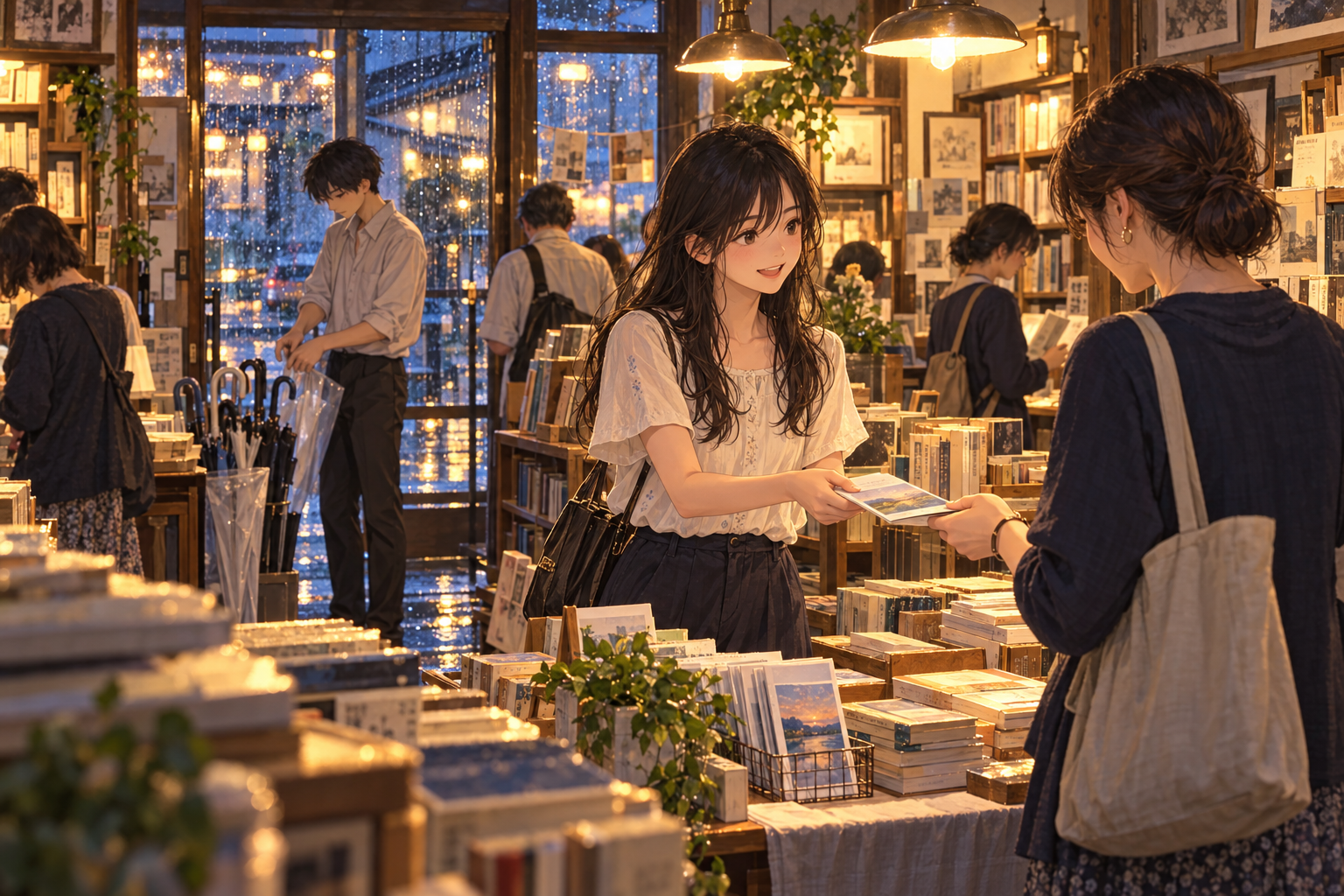
Tsubame Books was busier than I had expected.
Inside, the smell of wet umbrellas mingled with the smell of books.
They had added another mat at the entrance, and Ritsu was slipping a small child’s umbrella into a bag.
“Mio, could you give me a hand with that box?”
“Sure.
How far?”
“Beside the entrance.
Once you’ve carried it over, you’re done.”
I laughed and picked up the box.
People who took a booklet were looking from its pages to the sellers’ faces.
A customer who had read the florist’s introduction was asking, “Have you got any books that are scary even in daylight?”
The pages we had made were starting conversations we knew nothing about.
Halfway through the afternoon, a woman sitting beside the entrance spoke to me.
“This longer route was such a help.
I find the hill up from the station a little hard.”
“I’m glad,” I said, then added that I was the one who had made the booklet.
I hadn’t meant to say it, and surprised myself.
The woman looked at the imprint and read my name.
“Mio.
I’ll use this to get home too.”
That copy went into her bag.
The cover was slightly bent.
I thought it was all right for it to bend.
The rain didn’t stop before closing time.
No one blamed me for looking at the clock whenever there was a lull in the customers.
That only made me more embarrassed, and for the last hour I tried not to look at it at all.
Chapter 7: The Two of Us After I Said It
By the time we finished clearing up, it was dark outside.
Chiyo saw the sellers off, then went ahead into the living quarters behind the shop.
Ritsu and I locked the front door.
The rain wasn’t heavy, but the footing along the river didn’t look good for a walk.
“Shall we head towards the arcade?”
Ritsu asked.
I nodded and opened my own umbrella.
He opened that navy-blue one.
The edges bumped when we walked side by side, so we left a little space between us.
Along the way, Ritsu talked about the books that hadn’t sold that day.
I told him about the people who had taken the booklet home.
It frightened me that we could talk so normally.
We could just turn the corner like this and say, See you.
When we entered the arcade, we closed our umbrellas.
The bench we had sat on during our interviews was empty.
“Can we sit down?”
“Of course.”
I sat at one end and stood my umbrella in front of my knees.
Ritsu sat beside me, with less than a person’s width between us.
So close.
And yet I had no idea how to go any further from here.
“Ritsu.”
At his name, he turned towards me.
“I like you, Ritsu.”
My voice sounded more ordinary than I had expected.
“Part of it is that you’re leaving tomorrow, and I’m running out of time.
But I feel like if I don’t tell you, I’ll turn it into a story about a fun summer, all by myself.”
By then, I had run out of breath.
Ritsu said nothing.
He nodded and waited for what I would say next.
“I like being with you.
I want to see you even when there’s no work to do, even when it’s sunny.
I want to be closer to you than a friend.”
I was looking at my knees.
There were faint splashes of mud on the hems of my trousers.
I should have worn something prettier, at least today.
I was still thinking about things like that.
Ritsu said my name.
I looked up.
“Thank you for telling me.”
The moment I heard it, I prepared to put on a convincing smile.
But he didn’t stop there.
“I looked forward to seeing you too, Mio.
I want to keep talking to you when I’m back in Tokyo.
But right now, I don’t know if I can say I like you in the same way.”
Water dripping from my umbrella had made a little pool beside my shoe.
“Because we’ll be far apart?”
“I do think about that.
But I don’t think being close by would mean we could just start going out either.”
He spoke as though testing each word for himself.
“I know you’d feel better if I said we could be together now.
But I don’t really know whether I could keep things the same once I’m back, or, before any of that, whether I want us to be a couple.”
I pressed the fastening on my umbrella with my finger.
I fastened it, then undid it again.
“So, if I wait, will you know?”
I had meant not to ask, but I asked anyway.
Ritsu was quiet for a long time.
Somewhere, a shop shutter rattled down.
“I can’t ask you to wait.”
The answer hurt.
Being honest didn’t mean he couldn’t hurt me.
“I see.”
That was all I said.
Ritsu was beside me.
I wanted him not to go, and I wanted him to leave me alone, just for now.
Not knowing which to say, I looked at the wet ground.
After a while, he asked,
“Can I still message you?”
“…I don’t know yet.
Not today.”
“Okay.”
For the first time, I felt I had decided for myself that I didn’t have to give an answer.
When I rose from the bench, my knees were a little stiff.
Ritsu stood too.
We walked together to the end of the arcade.
I didn’t look for things to talk about anymore.
“You don’t have to come to the station tomorrow,”
Ritsu said.
“Okay.
I won’t.
I want to finish what I’m making.”
Some of it was putting on a brave face.
Even so, it was something I wanted to do.
I opened my umbrella.
His opened too.
I didn’t need to borrow one as I had on the first day.
“I’m glad I met you this summer,”
he said.
It would have been easy to say, Me too.
But after a moment’s hesitation, I chose different words.
“I can’t make this just a summer memory yet.”
Ritsu nodded.
“Okay.
I understand.”
He understood, and I was still sad.
I didn’t look back until I had turned the corner.
Then I looked back, just once.
From here, I could no longer see the road that led to the shop.
Chapter 8: The Next Reason to Go
On the day Ritsu went back, I woke at ten.
For the first time, I learned that you could sleep after crying.
It was past breakfast time, so I took an egg from the fridge and fried it.
When the yolk broke, I left it that way and put it on top of some rice.
When I sat at my desk, the booklet’s cover was waiting just as I had left it yesterday.
I wanted to show Ritsu.
That still hadn’t changed.
But having him look at it wasn’t the only reason I had started making it.
I went out to check the routes I was including once more, then came home and wrote the last page.
On September 10, I sent in my application.
The shop’s booklet, which Chiyo had given me permission to submit, and my own.
Both had my name in them.
I showed Akane the submission confirmation screen and got back “Finally” and a picture of dancing vegetables.
I messaged Ritsu the next day.
“I’ve applied.
I think there’ll still be days when talking to you hurts, but I want you to see what I’ve finished.”
I sent him the finished file, and that evening he asked if he could call.
I thought about it for twenty minutes or so, then replied, “If it’s fifteen minutes.”
Through the phone, I heard an ambulance and noises that seemed to come from the next room.
Where Ritsu was, it was an ordinary night I knew nothing about.
“You’ve written that it gets slippery beside the bakery when it rains.”
“Because you slipped.”
“I didn’t fall.”
“Your arms were going round pretty fast.”
After I laughed, it hurt a little.
Would I get used to that order of things eventually?
“I can hear your voice in the writing more now,” Ritsu said.
“Is that a compliment?”
“Yeah.
It’s only directions, but it feels like you’re right beside me, explaining.”
I was happy.
It was still so easy to make me happy.
A little after fifteen minutes, I was the one who ended the call.
There were days when saying goodnight and hanging up was much harder than saying goodbye.
After that, we didn’t message every day.
Ritsu sent photographs of his models.
I sent a mock-up with misaligned printing.
When his reply didn’t come until the next day, I wondered if he was with someone else.
Scolding myself for wondering grew a little tiring too, so I stopped.
At the end of September, the printing company told me I had passed the first round.
The interview was still to come.
Akane and I bought cake on the way home, and I told Chiyo at the shop.
That night, I sent Ritsu a short message.
“Congratulations.
Good luck with the interview.
Put on that knowing look.”
I laughed out loud and replied, “That’s exactly what I shouldn’t do.”
Once October came, the evening rain turned cold.
The date was set for our college trip to a printing exhibition in Tokyo.
We would have the afternoon free, and I planned to visit a small book exhibition I had been curious about.
It was somewhere Ritsu could reach by train from his university.
All the way home on the bus, I thought about whether to invite him.
Even if we met, his answer might not change.
He might feel further away than before.
I still couldn’t casually call us friends.
And yet, if someone asked whether I wanted to see him, I knew my answer.
When I got home, I booked one place at the exhibition.
Then I sent Ritsu my plans.
“I’ll be in Tokyo on the afternoon of the seventeenth.
I’m going to a book exhibition.
Do you want to meet afterwards?
I’d like to see you.
If it’s difficult, please tell me.”
After sending it, I cleared my desk.
I laid out the work I would take to the interview once more.
Outside the window, a bicycle’s brakes squealed.
Someone was hurrying through the rain.
There was still no reply from Ritsu.
I looked up the way to the exhibition.
The station had two exits, and the nearer one had stairs.
If it rained, I would take that big bag to keep my books dry.
No matter how often I folded it, the words FIFTY GYOZA hadn’t worn away.
I gathered the things I would need the next morning and put my umbrella by the front door.
This time, somewhere I wouldn’t forget it.
夏凪伊織
Your chapter is saved only in this browser on this device. No account is needed and your reading position is never sent. Progress is kept for up to 20 works, for 180 days after the last save.